When my teen daughter broke her leg at school, everyone called it a simple accident. I was stunned when her classmates buried our porch in get-well cards — my daughter wasn’t exactly popular. Then one boy stepped up and told me the gut-wrenching truth about what had really happened to her.
For the longest time, the only thing I ever worried about with my daughter was how few friends she had.
Monica was a great kid. She kept her grades up and never caused trouble.
She was also on the shy side, and that made connecting with people hard for her. It seemed like her one real friend was a boy named Oliver.
Then a terrible accident shattered every assumption I had about my daughter’s life.
It started out like any normal Friday.
> A terrible accident shattered every assumption I had about my daughter.
‘You’ve been really quiet this week,’ I said as I drove Monica to school. ‘Is everything alright?’
‘I’m fine, Mom.’ She gave me that small, tight-lipped smile she used whenever she wanted a subject dropped.
I didn’t buy it, but I let it go. I told myself she’d talk when she was ready.
That was my first mistake.
I pulled up to the curb outside the school and watched her climb out and walk over to Oliver. They headed through the doors together, and I drove off, with no idea that the next time I saw my daughter, she’d be lying in a hospital bed.
> That was my first mistake.
A few hours later, the school called.
‘This is the principal, ma’am. There’s been an accident during gym class. Your daughter has broken her leg and has been taken to hospital for treatment.’
The principal’s voice was measured, and the word ‘accident’ landed in my chest like a stone.
I drove to the hospital with my hands trembling on the steering wheel.
Monica was already in a room when I arrived, propped up against pillows, her left leg wrapped in a thick white cast that looked far too big for her body.
> ‘There’s been an accident during gym class.’
She gave me a small, tired smile. ‘Mom, I’m okay.’
‘You are not okay,’ I said, pulling a chair close to her. ‘What happened, sweetheart?’
She stared down at the blanket. ‘I slipped. In gym.’
> ‘Slipped how?’
‘Just… slipped.’ Her fingers picked at a loose thread. ‘It’s not a big deal.’
She was lying. I could see it in her eyes and hear it in her voice.
> ‘What happened, sweetheart?’
‘Monica. Look at me.’
She did, and her eyes were glassy.
> ‘Tell me what really happened.’
The principal stepped into the room before she could answer, all polished shoes and rehearsed concern. He shook my hand like we were closing a business deal.
‘These things happen, ma’am. Kids get wound up during physical activity. We’ve spoken with Mr. Daniels, and he’s just as upset as we are.’
> ‘Tell me what really happened.’
‘Mr. Daniels?’
‘Her gym teacher. He’s been with us for years.’ He offered a thin smile. ‘Unfortunately, Monica simply lost her footing during an exercise. Accidents happen, right?’
Something in his tone made the hair on my arms stand up.
I glanced at Monica. She was staring at the blankets, her face like stone.
I didn’t know it yet, but this was so much bigger than a broken leg.
> ‘Accidents happen, right?’
I barely slept that night.
Every time I closed my eyes, I saw Monica’s face, the way she’d looked down the moment I asked what happened.
Something wasn’t adding up.
And I had no idea that things were about to get a whole lot stranger.
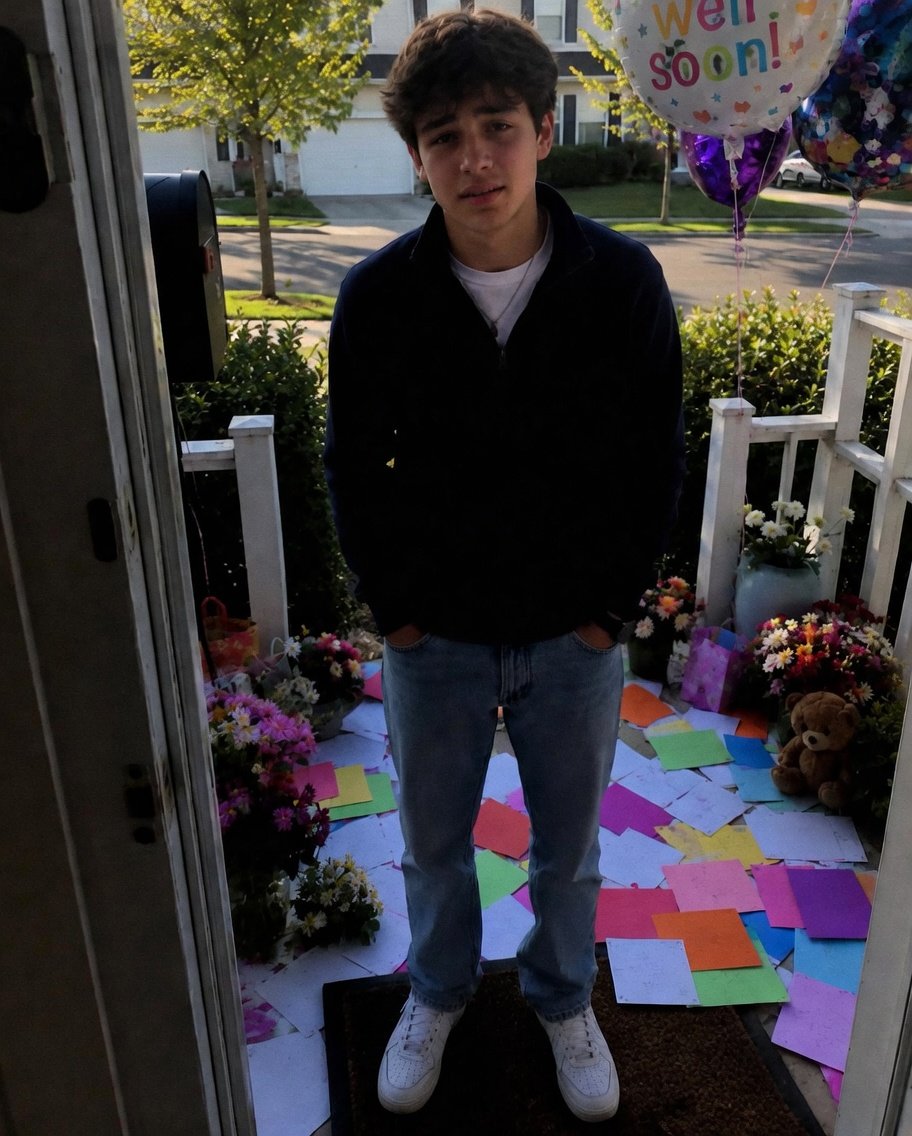
I opened the front door just after eight to drink my coffee on the porch, and nearly dropped my mug at what I found there.
> Things were about to get a whole lot stranger.
Get-well cards in every color were stacked along the porch railing and propped against the flowerpots.
Balloons bobbed in the morning breeze, tied to the mailbox. A small basket of cookies sat by the welcome mat. Two stuffed animals leaned against the doorframe like little sentinels.
And in the yard, a small cluster of kids stood watching me.
‘Oh,’ I whispered, my hand flying to my mouth.
> A small cluster of kids stood watching me.
Some I recognized from class photos. Some I didn’t.
They shifted their weight nervously, like they weren’t sure if they were welcome.
For years I had lain awake worrying that my daughter felt invisible. For years I had wondered why no one called, why no one ever came over, why her phone was always silent.
And here they were, standing on my lawn at eight in the morning, holding cards.
I thought they’d come because they cared about Monica, but the truth was far more complicated.
> For years I had worried that my daughter felt invisible.
I stepped outside.
‘You’re all so kind,’ I said, my voice catching. ‘Monica’s still asleep, but I’ll make sure she knows you came. Thank you. Thank you all so much.’
A few of them nodded. One girl set a small bouquet on the step.
They began drifting away in twos and threes, murmuring quiet goodbyes.
That’s when I noticed Oliver hanging back near the mailbox, half hidden behind it.
> I stepped outside.
The other kids filed past him, but he didn’t move, his eyes going from the house to the street and back again, like he was wrestling with a decision.
When the last of them had gone, he finally walked up the path. He was pale, and his hands kept clenching and unclenching at his sides.
> ‘Ma’am. Can I talk to you?’
‘Of course, sweetheart.’
Nothing could have prepared me for what Oliver said next.
> He finally walked up the path.
He glanced back over his shoulder at the empty street, then turned to face me. His voice dropped to almost nothing.
> ‘I think you should know what really happened to Monica.’
Something inside me went completely still. ‘What do you mean, Oliver?’
He swallowed hard. His eyes were wet. ‘She didn’t slip, ma’am.’
And the ground seemed to vanish beneath my feet.
> ‘She didn’t slip, ma’am.’
Oliver’s words hung in the air between us.
I gripped the porch railing and made myself breathe.
> ‘What do you mean, what really happened?’
He looked down at his sneakers. ‘Monica didn’t get hurt because she was being careless. She got hurt because she tried to stop Mr. Daniels.’
I tilted my head so I could see his face clearly. ‘Oliver. Tell me everything. Take your time.’
> ‘Monica didn’t get hurt because she was careless.’
He swallowed hard. ‘He was making some of us climb the high ropes. No mats. He said mats were for babies.’
My chest tightened.
‘There’s this girl, Lily,’ he went on. ‘She was crying. She kept saying she couldn’t do it. Mr. Daniels laughed at her. Told her to stop being so dramatic.’
‘What does that have to do with Monica?’
> ‘She was crying. She kept saying she couldn’t do it.’
‘Monica said it wasn’t safe. She told him right out loud, in front of everyone. He told her to sit down and be quiet.’ Oliver’s eyes were wet now. ‘But Monica didn’t listen. She climbed up after Lily to help her get down. That’s when she fell.’
It felt like someone had lit a fire inside my chest. ‘The principal told me it was an accident. Why did he lie?’
‘Mr. Daniels told us what to say. He said if anyone talked, he’d fail us. He told the principal Monica was goofing around.’
I decided right then that I was not going to let this go.
> ‘That’s when she fell.’
I thanked Oliver, then went straight inside.
Monica was on the couch, her cast propped on a pillow.
‘Monica, Oliver told me what really happened,’ I said, sitting beside her. ‘Why didn’t you tell me?’
Her eyes filled with tears. ‘I was scared, Mom. He said it would only make things worse.’
I took her hand. ‘Worse for who?’
She didn’t answer. She didn’t have to.
Monday morning, I was at the school before the first bell rang.
> ‘He said it would only make things worse.’
The principal’s secretary tried to wave me off, but I walked past her and knocked on his door.
‘I need ten minutes,’ I said when he opened it.
He gestured to a chair. ‘Of course. What can I do for you?’
‘My daughter was hurt because Mr. Daniels ignored a safety concern,’ I said. ‘What’s being done about it?’
The principal nodded calmly. ‘We reviewed the incident according to school procedure. It was simply an accident.’
That was the moment I realized someone wanted this buried.
> ‘What’s being done about it?’
‘Then your procedure missed something,’ I replied, keeping my voice as level as I could.
He shrugged. ‘If you have evidence that contradicts the report, you’re welcome to submit it to our office.’
> ‘And then what?’
‘We’ll evaluate it.’
His answers were polite. Professional.
But every response felt like another form to fill out. Another delay. I wanted action.
> ‘We’ll evaluate it.’
I stood. ‘My daughter deserves better than paperwork.’
‘And we take every concern seriously,’ he said.
I looked at him for a moment.
Somehow that sounded less like a promise and more like a brushoff.
By the time I reached my car, I knew one thing for certain.
If I wanted answers, I wasn’t going to get them by sitting back and waiting.
> ‘My daughter deserves better than paperwork.’
I sent a string of emails over the following days. Every reply said someone would ‘look into it.’
Every answer sounded reassuring.
By Wednesday, nothing had actually changed.
That’s when I understood the school wasn’t waiting for evidence. They were waiting for me to get exhausted and give up.
So I switched tactics. Something they wouldn’t be able to ignore or smother with paperwork.
> I sent a string of emails over the following days.
I started calling parents.
By Thursday, I had spoken to nine families.
Three of them told me their kids had complained about Mr. Daniels before. One mother had even submitted a written report a year ago.
Nothing had come of it.
So I started a group chat and put together a plan to force the school to act.
> One mother had even submitted a written report a year ago.
That evening, I sat in the living room for a long time, staring at the cards Monica had taped to the wall above the couch.
I had spent years believing my daughter was lonely. That she was the quiet one in the corner who needed me to clear the way for her.
But all along, she had been far braver than I ever gave her credit for. Brave enough to stand up for someone else when it truly counted.
I had to make sure her moment of courage wasn’t swallowed up and forgotten.
> She had been far braver than I ever gave her credit for.
The next morning, I picked up the phone and started making the calls that would bring every parent, every quiet complaint, and every silenced student into the same auditorium.
The cards on my porch hadn’t only been an act of kindness. They had been a community’s unspoken gratitude, waiting for someone to finally say it out loud.
Principal Harris was halfway through a speech about student safety when I pushed the auditorium doors open and walked in.
Every head turned.
> The cards on my porch hadn’t only been an act of kindness.
I walked in first.
Behind me came a dozen other parents.
The principal lowered the microphone. ‘Ma’am, what are you doing here? You can’t just walk in—’
I lifted a thick folder. ‘You asked for evidence that Mr. Daniels was negligent. I brought it.’
The room went silent.
> ‘You asked for evidence that Mr. Daniels was negligent. I brought it.’
Principal Harris looked at the parents behind me.
Then at the students.
Then back at the folder in my hands.
> ‘This isn’t the time or place—’
‘No?’ I cut in. ‘You’re up there talking about student safety. My daughter broke her leg because safety concerns were dismissed. That sounds like exactly the right place to me.’
A murmur moved through the room.
> ‘My daughter broke her leg because safety concerns were dismissed.’
Oliver stood up. ‘Monica warned Mr. Daniels it wasn’t safe. I was there. I heard her.’
A slight, nervous-looking girl rose next. ‘I told him I couldn’t do it, but he wouldn’t let me come down.’
Then another student stood.
And another.
Each story was different.
But they all pointed to the same thing: Mr. Daniels’ negligence.
> ‘I told him I couldn’t do it, but he wouldn’t let me come down.’
For the first time, Principal Harris looked genuinely shaken.
Slowly, he took the folder from my hands and flipped through complaint after complaint.
The auditorium grew so quiet I could hear the pages turning.
Finally, he looked up. ‘Effective immediately, the district will open a formal investigation into these allegations.’
Nobody applauded.
This wasn’t a triumph in the usual sense. It was a more solemn kind of victory. The truth was finally out in the open, where it could no longer be ignored.
> For the first time, Principal Harris looked genuinely shaken.
Two weeks later, Mr. Daniels was placed on administrative leave while the district carried out its investigation.
A month after that, his employment was terminated.
The district also announced new safety requirements for gym classes and created a formal process for students to report concerns directly.
***
One afternoon, after Monica’s cast came off, she sat on the porch steps with Oliver on one side of her and Lily, the girl she had defended, on the other.
> A month after that, his employment was terminated.
‘I still can’t believe everyone showed up for me like that,’ I heard Monica say quietly. ‘All those cards and gifts from people I didn’t even think knew my name.’
‘You became a hero that day,’ Oliver replied, nudging her with his elbow.
Monica laughed. ‘Don’t be ridiculous.’
But as I turned away, I couldn’t help thinking Oliver was absolutely right.
Monica didn’t break her leg because she was reckless. She broke it protecting someone else. And the truth of that had finally caught up with the people who had tried so hard to bury it.
> ‘You became a hero that day.’