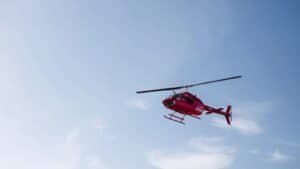
It was supposed to be a normal drive home.
Traffic. Red taillights. The low hum of engines settling into that early-evening rhythm when everyone’s thinking about dinner, not disaster.
Then the sky changed.
At first, people thought it was just another helicopter passing overhead. Nothing unusual. Sacramento sees them all the time. Most drivers barely look up anymore.
But this one didn’t sound right.
Several witnesses later said the noise felt “off,” like the air itself was struggling. A few glanced up out of instinct, not knowing why their stomachs suddenly tightened.
And then everything dropped.
The aircraft came down fast. Too fast. Spinning, wobbling, losing control in a way that made it instantly clear this wasn’t a routine landing.
Cars slammed on brakes. Horns blared. Someone screamed.
Seconds later, it hit the highway.
Flames burst across the asphalt. Smoke shot upward, thick and black, swallowing the evening light. Drivers froze in place, trapped in their cars, watching something they couldn’t quite process.
One man later said he sat there gripping the steering wheel, whispering, “No, no, no,” like that might rewind what he was seeing.
It all happened around 7 p.m., right when Highway 50 is packed. Eastbound lanes. An area most locals know well. Familiar. Ordinary.
Until it wasn’t.
Sirens came fast. Fire trucks, police cruisers, ambulances—so many that it felt like the entire city had turned toward that stretch of road at once.
Fuel leaked. Debris scattered across lanes. Firefighters moved carefully, knowing one wrong step could make things worse.
Inside the wreckage, there were people.
Three of them.
No passengers. No patients. Just the crew.
That detail mattered more than anyone wanted to admit.
The helicopter had just lifted off from UC Davis Medical Center. It was heading north, toward Redding, another routine flight that was supposed to end with everyone stepping out alive.
Instead, the pilot, a flight nurse, and a paramedic were pulled from twisted metal and fire.
All critically injured.
Rescue teams worked against heat, smoke, and the very real fear that the aircraft could ignite again. Officials later described the extraction as “extremely difficult,” the kind of situation emergency crews train for but hope they never face.
Miraculously, no one on the highway was hurt.
That fact alone feels unreal when you picture the scene. A helicopter crashing onto a busy freeway during rush hour—and not a single driver struck.
People kept saying the same thing afterward: How did that not kill more people?
Traffic in both directions stopped cold. Some drivers sat for hours, unable to move, staring at flashing lights and rising smoke. Others abandoned their cars and walked along the shoulder, calling loved ones with shaking hands.
Social media filled with photos before officials could even speak. Flames against the darkening sky. Twisted wreckage where cars should have been.
Rumors spread faster than facts.
Was it mechanical?
Was it pilot error?
Was anyone dead?
Answers were slow.
Authorities eventually confirmed the three crew members had been rushed to nearby hospitals. ICU. Critical condition. Families notified. Names withheld.
And that’s when the story shifted from shock to something heavier.
Because these weren’t just people caught in an accident.
They were the ones who usually show up after accidents.
Air medical crews. The people who fly when seconds matter. The ones who land in places most pilots avoid, carrying patients who don’t have time for traffic or distance.
They risk this every day, and most of the time, no one thinks about it.
Until something goes wrong.
Investigators from the FAA and NTSB arrived quickly. Joint investigation. Standard procedure. But that phrase doesn’t bring comfort when people are still fighting for their lives.
Early indications hinted at a possible mechanical issue shortly after takeoff. Nothing confirmed. Too soon to say. Flight data and maintenance records would need time.
Witness accounts would be combed through. Traffic cameras reviewed frame by frame.
Every detail mattered now.
Meanwhile, the freeway remained closed. Crews worked lane by lane, clearing debris, checking the road surface for damage, making sure no hidden fuel pockets remained.
The smell of smoke lingered long after the flames were out.
At UC Davis Medical Center, staff members quietly checked updates between shifts. Nurses and doctors who work alongside air crews every week stood together in hallways, shaken.
One nurse said it out loud when others couldn’t: “That could’ve been any of them.”
Online, people began organizing. Donation links. Messages of support. Blood drives. Prayer requests shared by strangers who had never met the crew but felt connected anyway.
Because there’s something about a rescue helicopter crashing that hits differently.
It flips the script.
The ones who rush toward danger suddenly need saving themselves.
Officials reminded the public that air medical crashes are rare. That safety protocols are strict. That flying remains one of the fastest ways to save lives across California’s vast and rural areas.
All of that can be true—and still feel hollow in moments like this.
As night fell, Highway 50 slowly reopened, lane by lane. Drivers passed the area cautiously, some rolling down windows, others looking straight ahead, not wanting to see what was left.
But the questions didn’t clear with the road.
What failed?
Could it have been prevented?
How close did this come to being even worse?
Those answers will take weeks. Months.
For now, three families wait in hospital rooms, listening to machines, hoping for movement, improvement, anything.
The city moves on because it has to.
But that stretch of highway won’t feel the same for a while.
And every time a medical helicopter lifts off into the Sacramento sky, someone will look up just a little longer than before, wondering how fragile that moment really is.